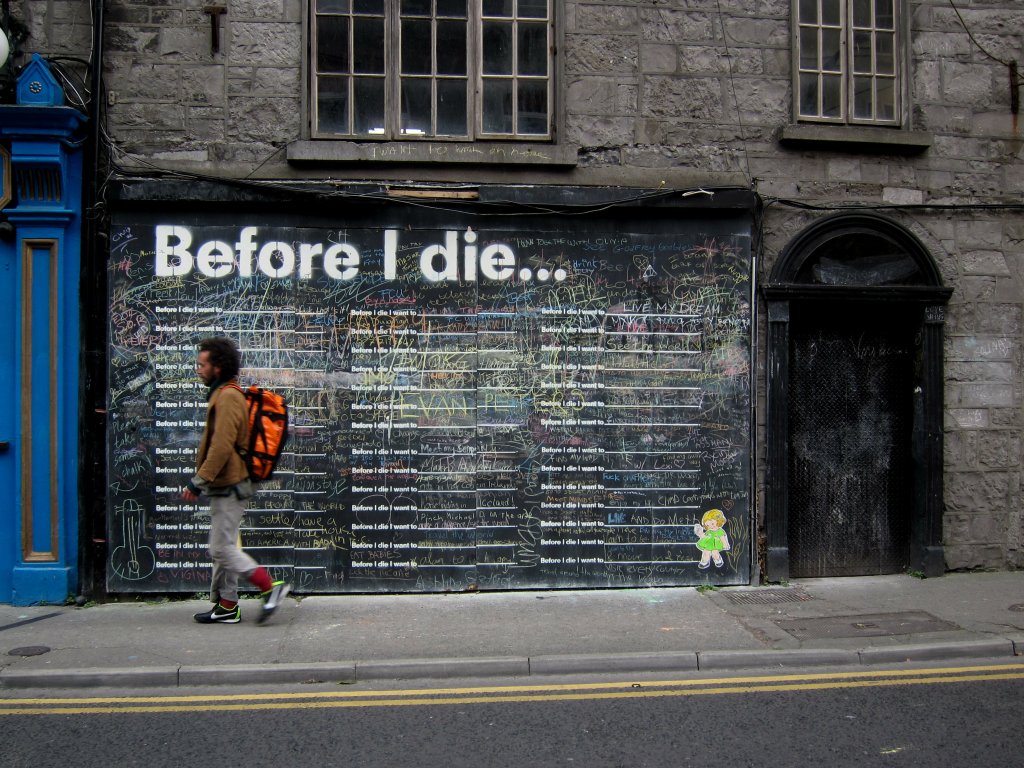
Has your doctor ever asked you about your bucket list? An article in the Journal of Palliative Medicine suggests that discussing bucket lists can be a useful way to engage patients with chronic or serious illnesses in conversations about their treatment options.
If you’re unfamiliar with the term, a bucket list is a collection of experiences or goals someone hopes to accomplish before they die (a nod to the phrase “kick the bucket”).
The thinking goes that when doctors understand what matters most to their patients—what they still hope to do or achieve—they can help them make more informed decisions about treatment. This includes considering how a treatment plan might support or hinder those goals.
Too often, healthcare focuses narrowly on disease management without taking the broader context of a patient’s life into account. For example, if someone with cancer has always dreamed of visiting the Eiffel Tower, it might be important for them to understand whether travel is possible during treatment or if delaying treatment briefly to fly to Paris would be safe and worthwhile. If their medical team never asks about their goals and dreams, treatment might begin immediately, and the chance to take that trip could be off the table, maybe forever.
These kinds of conversations are just as relevant for less life-threatening conditions. A music lover on immunosuppressants for rheumatoid arthritis might wonder if it’s safe to attend live concerts with large crowds. A tennis player facing a knee replacement might need clarity on whether they can continue playing after surgery before they opt to go under the knife.
So, what’s on your bucket list? And how many of those goals have you ever discussed with your doctor?
The article included a list of common bucket list items gathered from over 3,000 submissions. I was curious to compare them with my own…
Common Items on a Bucket List
The researchers identified six major themes across the 3,000 bucket lists they reviewed, along with examples from each:
- Travel (e.g., cycle in Italy and France, visit presidential libraries, and travel to see the Pyramids)
- Accomplish a personal goal (e.g., run a marathon, drive a Porsche, acquire my Master’s to become a Pathology Assistant)
- Achieve specific life milestones (e.g., see my grandchild in Iowa, have a daughter, stay with my husband through everything)
- Spend more quality time with friends and family (e.g., spend time with old friends, spend time with beloved pets, spend time with all of my children together at the same time)
- Achieve financial stability (e.g., debt-free by 45-years-old, save enough money for kids’ college, retire comfortably)
- Do something daring (e.g., bungee jumping, go on a zipline, fly a P51 Mustang)
My Bucket List
Personally, I refer to mine as a Life List since it includes both once-in-a-lifetime experiences and ongoing habits or behaviours I want to cultivate. Like the study participants, many of my goals fall under travel and personal growth, but my list has eight categories:
- Learning and Growth (e.g., learn a second language, do five unassisted pull-ups)
- Do Good (e.g., be a lifelong volunteer, create and fund a scholarship)
- Travel Experiences (e.g., visit all of the Canadian dark sky preserves, hike sections of the Kumano Kodo pilgrimage)
- Leisure (e.g., become a stronger swimmer, read several books per month, join a climbing gym)
- Kitchen Goals (e.g., make a croquembouche for someone’s birthday, attempt homemade bagels)
- Dining Out (e.g., have dinner at Pilgrimme on Galiano Island, eat oysters at The Oyster Shed in the Isle of Skye)
- Lifestyle (e.g., live abroad for a year, minimize my possessions)
- Luxuries (e.g., fly first class, take an overnight trip in a fancy train)
If you haven’t created your own bucket list (or life list) consider giving it a try. I keep mine in the Notes app on my phone for easy updates and reflection, but there are also free apps that can help you stay organized.
Reference:
Periyakoil, V.S., Neri, E., & Kraemer, H. (2018). Common items on a bucket list. Journal of Palliative Medicine, 21(5), 652-658. https://www.liebertpub.com/doi/10.1089/jpm.2017.0512
Image: Dublin (2015).
 My Fine Lines
Leave a comment